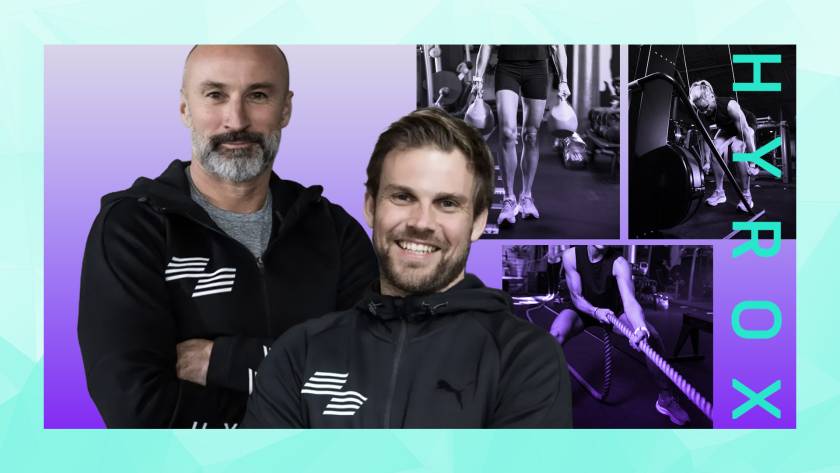
Hyrox has had a couple of big weeks. A world record holder emptied her bowels all over herself mid-race in Beijing and kept going. Less well known, a few days earlier, the company reportedly changed hands for around US$700 million (AU$983 million), and the two founders came out owning more of it than before.
Last May, Jason Andrew assessed that Hyrox was doing around US$140 million (AU$197 million) in revenue from 650,000 participants across 83 events. According to Andrew’s estimate, gross margins were near 80%, largely because their event packs up and moves to the next city each week. At the time, the founders said there was no exit planned.
Just 16 months later, the reported numbers were US$270 million (AU$379 million) in revenue, 1.4 million participants, and more than 100 events in 30 countries.
Hyrox’s Three Sales
Christian Toetzke and Moritz Fürste started Hyrox in Hamburg in 2017. Since then they have sold equity three times.
In December 2019 they sold a minority stake to Infront Sports and Media, a Swiss sports marketing group that sells sponsorships and events. Hyrox was 14 events a season at that point. Infront’s announcement said the investment would “accelerate that growth further”. Then Puma, Red Bull, and the other big partners got on board. This is exactly what Hyrox needed to grow fast.
Smarter business news. Straight to your inbox.
For startup founders, small businesses and leaders. Build sharper instincts and better strategy by learning from Australia’s smartest business minds. Sign up for free.
By continuing, you agree to our Terms & Conditions and Privacy Policy .
Related Article Block Placeholder Article ID: 315968
Financial teardown: How Hyrox turned training into a US$140 million global sport
Then, in October 2022, Toetzke and Fürste sold control, with Infront owning just over half the company. Hyrox was at 45 events a year, across six countries with about 90,000 participants. HYROX planned expansion into the UK, North America, the Middle East, and Hong Kong. Toetzke’s target was half a million participants within four years.
In 2026, their four-year target of 500,000 was beaten nearly by nearly 3x and ahead of schedule.
In September 2026, Infront sold its whole stake to a group led by L Catterton, the private equity firm backed by LVMH, with Jeffrey Katzenberg’s WndrCo alongside. In this deal, Toetzke and Fürste are reported to have increased their combined ownership from 40% to 51%, with L Catterton and WndrCo holding the remaining 49% as minority partners.
Toetzke and Fürste understood that scaling from 14 events a season to 100 or more requires serious capital. It’s the gotcha that stops most small business growth. They understood that owning as little as 40% of a company worth $500 million is worth more than 100% of one that stays small.
The full terms are not public. What is known is that Toetzke and Fürste kept their shares and bought back roughly 11% of the company for approximately US$70 million (AU$98 million). They reportedly funded that with cash from earlier deals plus personal borrowing. L Catterton and WndrCo bought the rest.
How small business owners can grow using the same strategy
Keep as much as you can while getting the capital you need.
Pick a partner for what they can do, not just what they will pay.
Before closing the deal, agree in writing what happens when they want out. You want first right to buy their shares, and a say in who they sell to if you can’t.
What an investor looks for
While your business might not be in the running for a deal that size, the same strategy plays out on a smaller scale in Australia with smaller private equity firms.
Altira Private Equity is looking to invest $100 million into Australian small businesses with profits between $1 million and $10 million. “We are not looking for a business that needs us to run it,” says Gary Brown, Head of Investments at Altira Private Equity. “We are looking for companies who know exactly where the next stage of growth is and who cannot get there on their own balance sheet.”
Brown says the businesses that get funded share three things: earnings that do not depend on the founder’s personal relationships, a management layer that can run the week without them, and a growth plan that is specific. “If an owner can show me those, we become very interested.”
Hyrox will be fine after Beijing
The founders apologised within 48 hours, changed the rulebook, and announced refunds for everyone else who ran after that day. Ultimately, they were very lucky it all happened after the deal closed.
The Beijing controversy is what people will remember this month, but the deal is what’s really interesting. Two founders sold control of their company, used someone else’s money and resources to grow 7x, and bought control back. Now, that’s a great story.
Jaime Almond is a business advisor specialising in helping business owners prepare for a successful exit and get the best possible sale price. She loves digging into business financials and is passionate about technology and innovation.
Recommended for you
Jason Andrew May 7, 2025
Why Sweat isn’t scared of fitness trends like Hyrox and run clubs
David Adams Mar 5, 2025
SME finance expert Jason Andrew joins SmartCompany as weekly columnist
Eloise Keating May 29, 2025