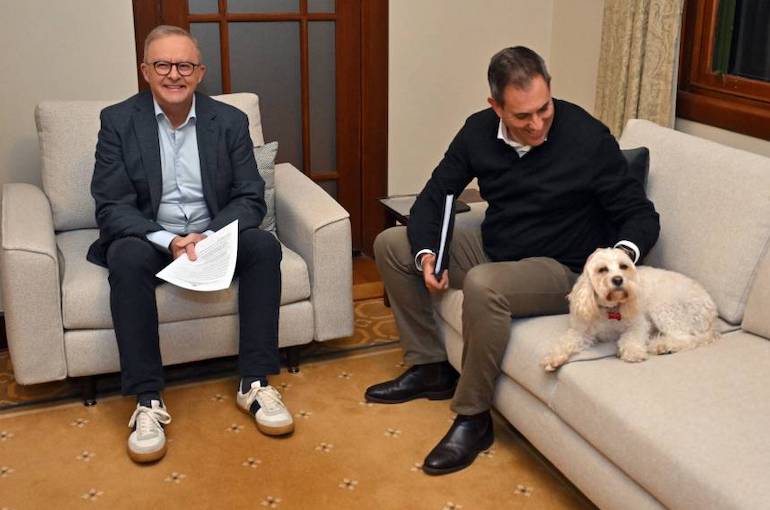
Treasurer Jim Chalmers is expected to use next week’s federal budget to boost support for research and development (R&D). But the move risks being overshadowed by a growing concern over possible changes to the capital gains tax (CGT).
As first reported by the AFR , the government is looking to raise the current $150 million cap on eligible R&D expenses as part of a broader productivity push in the budget.
Bigger R&D tax breaks expected
The reported R&D changes would stop short of recommendations made in the Robyn Denholm-led Ambitious Australia review, which called for the current cap to be removed entirely.
Instead, the government is likely to lift the threshold to between $250 million and $300 million.
The review warned Australia’s innovation system is falling behind global peers, with business expenditure on R&D declining over the past 10 years.
However, it’s worth noting that change would primarily benefit larger R&D-heavy companies. The latest ATO transparency data shows Atlassian recorded more than $220 million in eligible R&D expenditure in 2022-23. Other major beneficiaries included Fortescue, Cochlear, CSL and ResMed.
Get the best of Startup Daily straight to your inbox
Want to know the latest in startup news? Subscribe to our daily news and analysis coverage on what’s happening to ANZ startups, investors and the broader ecosystem. And best of all, it’s FREE!
By continuing, you agree to our Terms & Conditions and Privacy Policy .
For smaller startups, however, the current model for the R&D Tax Incentive remains one of the federal government’s most significant innovation measures. This is because businesses with a turnover below $20 million can access refundable offsets.
Warnings over CGT changes
Meanwhile, the government’s broader tax reform agenda is already causing concern across the startup ecosystem.
Chalmers is widely expected to make changes to the 50% CGT discount , with reports suggesting the government is considering replacing it with an inflation-indexed model.
The concern for startups is that equity is often used to attract founders, talent, and investors willing to take significant risks in exchange for the possibility of a future payout if a company is acquired or goes public.
That model becomes a harder sell if the eventual tax treatment of those gains becomes less attractive, particularly in a market already competing internationally for talent and capital.
The issue is that both measures are being framed through the same productivity lens.
On one hand, lifting the R&D cap is designed to encourage more local research, commercialisation, and high-value activity in Australia.
On the other hand, startup investors argue changes to CGT could make Australia less attractive for exactly the kind of risk-taking the government says it wants to encourage.
The budget is also expected to include other business-focused measures, including a possible permanent extension of the $20,000 instant asset write-off for small businesses, an earned income offset , and a minimum 30% tax rate on trust distributions.
This story first appeared on SmartCompany . You can read the original here.
A multi-award-winning journalist, Tegan has been reporting on technology, telecommunications and gaming for the past 10 years. She regularly appears on mainstream media channels as an expert tech commentator. Her previous roles include editor of Gizmodo Australia and global reviews editor at Finder. She has also served as a reporter and editor across Business Insider, Lifehacker and Kotaku Australia. Tegan is also the co-host of one of the top technology podcasts in Australia, Weird Tech. You can find her on Twitter @Tegan_Writes.
Recommended for you
Startup investors may dodge CGT changes after all
Tegan Jones May 12, 2026
Here are Labor’s Budget tweaks on CGT after startup backlash
Jacob Shteyman Jun 18, 2026
Super ideas: Treasurer Jim Chalmers scraps the biggest threat to startup investment – the unrealised gains tax on superannuation
David Adams & Simon Thomsen Oct 13, 2025