
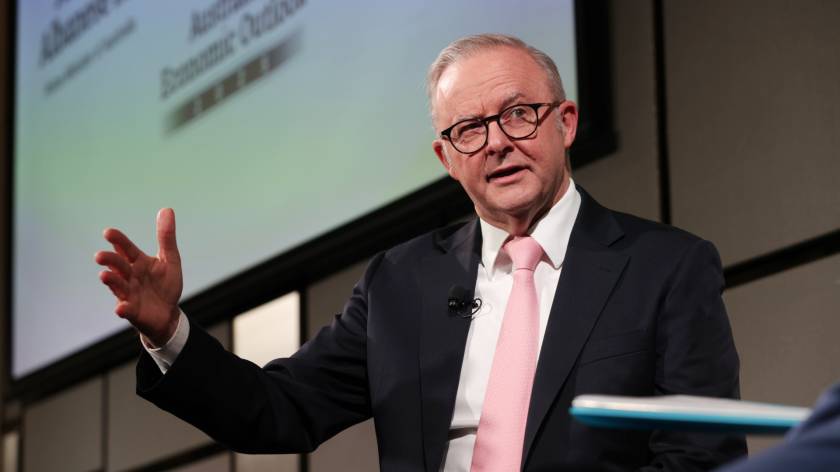
Prime Minister Anthony Albanese has declared artificial intelligence a key pillar of Australia’s future economic model, saying it must support secure employment and national productivity.
Speaking at News Corp’s Economic Outlook forum on Friday, and first reported by Innovation Aus , Albanese said Labor would focus on building skills, removing regulatory barriers, and enabling business-led adoption of new technology.
“As a Labor government, we are determined to create the right framework and make the right investments in skills and training to ensure artificial intelligence is a contributor, not a competitor. An enabler of secure and fulfilling jobs, not a threat to them,” Albanese said.
Albanese used the speech to position AI, renewables, and critical minerals as the backbone of Australia’s new productivity model — one that supports local manufacturing and research commercialisation rather than relying solely on labour cost competitiveness.
“The world is moving beyond the old equation, which held that high-wage, open economies like Australia could not sustain manufacturing locally, because we could not compete on price internationally.
Smarter business news. Straight to your inbox.
For startup founders, small businesses and leaders. Build sharper instincts and better strategy by learning from Australia’s smartest business minds. Sign up for free.
By continuing, you agree to our Terms & Conditions and Privacy Policy .
Instead in the years ahead, comparative advantage in manufacturing will not be defined by minimising the cost of labour. It will be secured by the most productive use of technology, by cutting transport costs and by cheaper, cleaner energy.”
The Prime Minister also pitched a reduced regulatory burden for businesses, arguing governments should facilitate, not replace, private sector investment .
“In a strong, dynamic and productive economy, government should be a driver of growth – but not the driver of growth.”
OpenAI enters the Australian chat
Related Article Block Placeholder Article ID: 319090
Give Australian companies tax breaks for using AI: ChatGPT owner
The speech landed just days after OpenAI unveiled its AI Economic Blueprint for Australia, a report claiming AI could add $115 billion annually to the economy by 2030, mostly through productivity improvements.
OpenAI’s chief economist Ronnie Chatterji visited Canberra last week to meet with senior ministers, including Tim Ayres, Andrew Charlton and Andrew Leigh, calling on the government to introduce targeted tax breaks , workforce training, and a streamlined national approval process for AI infrastructure.
“A lot of these technologies have created complements to workers, not substitutes,” Chatterji said.
The report also argues Australia could become a regional AI hub, provided it invests in sovereign compute, renewables-powered infrastructure, and local capability. Without policy action, OpenAI warns, Australia risks falling behind as other countries move more decisively.
Australia weighs up AI trade with China
Albanese’s comments also come as China proposes expanding its free trade agreement with Australia to include AI and digital economy provisions, just ahead of the Prime Minister’s visit to Beijing this week.
Related Article Block Placeholder Article ID: 292864
China may have removed tariffs on Australian wine but its market is no longer the same
James Laurenceson AND Weihuan Zhou
Chinese ambassador Xiao Qian has urged Albanese to embrace AI as a new growth area for bilateral cooperation. But the pitch has raised red flags among security experts, who warn deepening digital ties with Beijing could leave Australia vulnerable to coercion and technological lock-in.
The AI trade offer also arrives against the backdrop of rising tension with the United States, following Donald Trump’s re-election and the imposition of sweeping new tariffs on Australian exports. The geopolitical balancing act adds further complexity to Australia’s emerging AI strategy.
Labor’s post-election AI pivot
Over the past couple of years, the federal government has leaned into a “safe and responsible” AI message, emphasising workforce training through initiatives like the national AI course developed by TAFE, CSIRO and the National AI Centre.
But the tech sector has voiced frustration at the lack of coordinated investment and policy clarity, particularly after AI was omitted entirely from the 2025 federal budget.
Labor was also notably silent on tech and AI throughout the election campaign. That changed the morning after the election, when Treasurer Jim Chalmers used a post-election interview on Insiders to name AI as a top economic priority.
Since then, Labor has ramped up its AI messaging, with new ministerial roles , briefings from OpenAI, and a multi-day productivity summit now scheduled for August.
Former industry minister Ed Husic, who was removed from cabinet after the May election, publicly warned Labor against “timidity” in its tech approach, calling for bolder growth policies to strengthen sovereign capability and fuel innovation.
He was replaced by Tim Ayres , who has since signalled a larger role for unions in the AI debate, as business groups, regulators and policymakers prepare to debate how the benefits of AI adoption should be distributed across the economy.
While Labor has ramped up its AI rhetoric since the election, policy delivery remains patchy, with the long-awaited National AI Capability Plan still due “later this year”.
At the same time, the government has established AI Adopt Centres to support small business adoption, and appointed Andrew Charlton to a new Digital Economy role tasked with helping bridge the gap between innovation and regulation.
Whether Labor’s AI pivot holds will depend on what actually gets delivered, not just flagged at another summit.
Never miss a story: sign up to SmartCompany’s free daily newsletter and find our best stories on LinkedIn .
A multi-award-winning journalist, Tegan has been reporting on technology, telecommunications and gaming for the past 10 years. She regularly appears on mainstream media channels as an expert tech commentator. Her previous roles include editor of Gizmodo Australia and global reviews editor at Finder. She has also served as a reporter and editor across Business Insider, Lifehacker and Kotaku Australia. Tegan is also the co-host of one of the top technology podcasts in Australia, Weird Tech. You can find her on Twitter @Tegan_Writes.
artificial intelligence
Recommended for you
OpenAI agent hacked Medicare website, says PM
Andrew Brown Sep 24, 2026
Companies to face stiff penalties under new Australian AI safety laws
Simon Thomsen Nov 11, 2026
Australia lands $20 billion AWS data centre deal as Albanese backs AI push
Tegan Jones Jun 16, 2025