
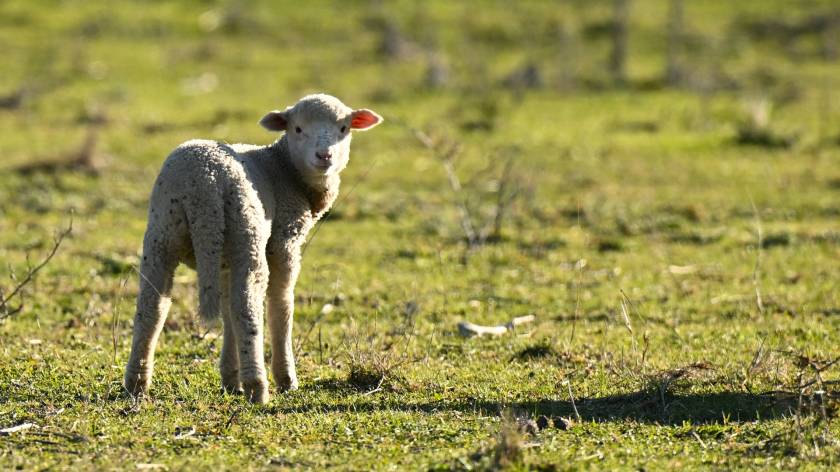
Australia rides on the sheep’s back, or so goes the time-worn saying about the worth of the meat and wool industry.
A sustainable fashion project is proving there is also plenty of value in the sheep’s head, legs, belly, and even its fluffy bottom.
The short fibres from these parts of a sheep, called locks, are usually considered of very low value and are either used for chunky knit garments or discarded.
Related Article Block Placeholder Article ID: 271110
Country Road injects $547,000 into three innovators providing climate solutions for the fashion industry
In a trial backed by Australian fashion brand Country Road’s climate fund , a group of innovators has developed a way to use locks to make a sustainable fine yarn ideal for clothing fabric.
“The same sheep that produces super-fine wool used in a nice suit or a jumper … the bits that they generally can’t use from the belly, the legs and the bottom are able to be used,” said Chris Hurren from Deakin University’s Institute for Frontier Materials.
Smarter business news. Straight to your inbox.
For startup founders, small businesses and leaders. Build sharper instincts and better strategy by learning from Australia’s smartest business minds. Sign up for free.
By continuing, you agree to our Terms & Conditions and Privacy Policy .
The Mud to Marle project, a collaboration between the institute, social enterprise Full Circle Fibres and textile manufacturer LoomTex, blended the South Australian locks with Queensland cotton.
The unique mix, which creates a stretch fabric without the need for synthetic fibres, has been used in prototypes for women’s suits, T-shirts, jumpers, pants and skirts.
The method has several sustainability benefits, including the need to dye only the wool threads to create a marle effect.
Dyeing the wool rather than the cotton saves on water and energy as the fleece more readily takes on colour.
The natural fibres are also environmentally friendly, associate professor Hurren said.
“There’s no synthetics in what we’re doing,” he told AAP .
“And if they’re uncoloured, or coloured with the right dyestuffs, they would be able to be broken back down into soil at the end of their lifetime.”
Related Article Block Placeholder Article ID: 316914
Fashion Council calls for parliamentary inquiry into Shein as ultra-fast fashion giant launches ‘Australia-inspired’ label
Mud to Marle has also demonstrated that low-impact, end-to-end textile manufacturing is possible in Australia.
The yarn spinning, usually done offshore, was completed using equipment at Deakin University before it was woven in Geelong and knitted and dyed in Melbourne.
The sample clothing, in warm shades of lilac and mango, was made in Sydney and Melbourne.
“The biggest challenge here is the narrative that (Australia) can’t make anything, but we can make loads of stuff,” Full Circle Fibres founder Meriel Chamberlin said.
“It’s that combination of not just the university, but of local manufacturers and their capability.
“That’s the bit that makes it possible. It’s a local ecosystem – it takes a village.”
Never miss a story: sign up to SmartCompany’s free daily newsletter and find our best stories on LinkedIn .
Stephanie Gardiner
Recommended for you
SmartCompany Holiday Gift Guide 2024: David Adams recommends Black Sheep
David Adams Dec 16, 2024
Sheep, solar and wine: The unlikely formula helping this winery boost profits
Stephanie Gardiner Aug 13, 2026
Uluu raises $16 million Series A to replace plastics with seaweed-based alternatives
David Adams Oct 30, 2025